Background
What problem are we solving?
The agriculture industry has seen significant growth and innovation. Yet, many growers still rely on labor intensive methods of scouting their fields. On average, it takes 3 hours to scout a field on foot, and only covers a small percentage of the field.
We tackled this issue by developing a drone-based scouting software where scouting can accomplished in minutes.
Help users make better decisions
Design an interface that gives growers a comprehensive view of their fields and help make informative decisions.
Sprint Goal
Accelerate the team
In one meeting, I asked what do you want out of this sprint. One person said: “Go go go” . The team has spent the past month running around in circles trying to tackle different things without an alignment. This sprint would bring the team together, have a clear vision, and accelerate the project.
The Team
As a cross-functional team with different roles and backgrounds, we were able to face the challenges with a wide range of perspectives and knowledge. Located in different geographical locations, it was critical to have a successful communication and coordination plans. Despite the distance and time-zone differences, the team collaborated closely to achieve the shared goals.
As the lead designer for this project, I drove the design sprint and designed the user-flows and the prototypes. I coordinated the sessions and report back our accomplishments to the leaderships.
My role
Empathy building through journey mapping
We kicked-off the sprint with customer journey mapping by contributing our own knowledge of the user and the problem space. Collaborating with Product team as well as Marketing, Agronomy, Education and Technical team, we successfully captured a holistic journey that covered all aspects of the user journey.
MVP generation and prioritization
(This is a Gif!)
Sketching Ideas and Intensive Feedback Discussion
Next step was working in silo to sketch out the ideas, and presenting back to the team.
I gave the team 3 days to complete the sketches so they don’t feel rushed, especially if sketching isn’t something they feel comfortable. The key here is to present sketches that captures great ideas and also legible so the team can comprehend and time boxing it would just stress people out.
We voted on ideas that would work the best, and spent 1.5 hours discussing on the ideas, adding notes on why it works and the potential risks.
After understanding the customer journey and addressing pain points, we brainstormed several “How Might We” to generate ideas for the MVP. Then we used the prioritization matrix to organize our ideas and focused on the low effort + high value to be part of the MVP.
Visualizing steps through user flow
After gathering ample of great ideas from the team and agreed direction of the product, I created the user flows to simplify the ideas. The framework helped the stakeholders have a clear vision of the product at a glance.
The Design Sprint
Delivering Prototype
As the last phase of the sprint, it was up to me to deliver a prototype that is a combination of all our ideas. Having spent hours together brainstorming and discussing, I gave the team a break as I worked on the prototype. I showed some early wireframes and gathered feedback as well.
After a week and multiple cortados, I delivered the prototype that consist of the MVP we all successfully aligned on.
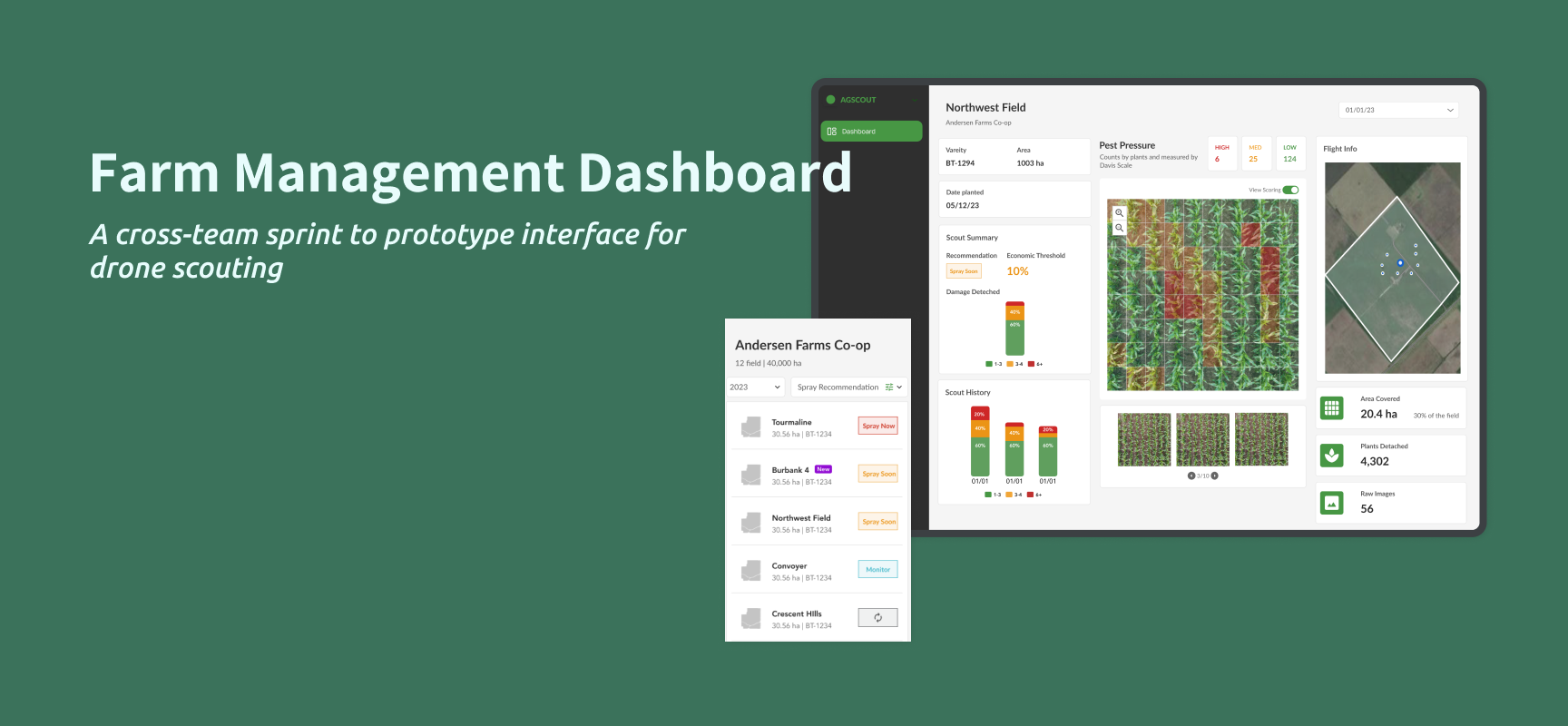
Field cards consist of basic information such as field name, shape, acreage as well as scout results.
As a user, being able to view their fields in specific organization will help with their workflow efficiency. Thus, I added a drop down menu that helps a user view field by (for example) date scouted so they can see what fields were last scouted.
View fields list by what matters the most
Once in a field detail page, the dashboard consists of field info, scouted data, scouted data history, raw images with or without scoring, and flight info.
All this information to help them make decision for crop protection: pest pressure, location of pest pressure, and the spray recommendation depending on the threshold of the pest pressure.
A closer look to manage crops
Key learnings
Resources: Following the structure from Sprint by Jake Knapp and practicing the learnings from IDEO U course Cultivating Creative Collaborations, I was equipped with both hard skills and soft skills to successfully facilitate a design sprint.
Time constraints: Running a 10-person sprint across different time zones, scheduling was a challenge. I schedule 1-hour sprint time for 6 weeks considering people’s busy calendars. My next sprint, I would make it a full or half day sprint in consecutive days to keep a momentum.
Leadership: What I found worked was strong communication, shared mission, and confident. No doubt, I was anxious having to lead leadership and of the unknown. Before the sprint, I told George, Senior Designer, “I am prepared and feeling good about the sprint tomorrow, yet I’m nervous about something going wrong, and I don’t know what that something is”. But being mentally prepared for the unknown, I was at ease when we ran into bumps and ditches.